Why are aphids so successful?
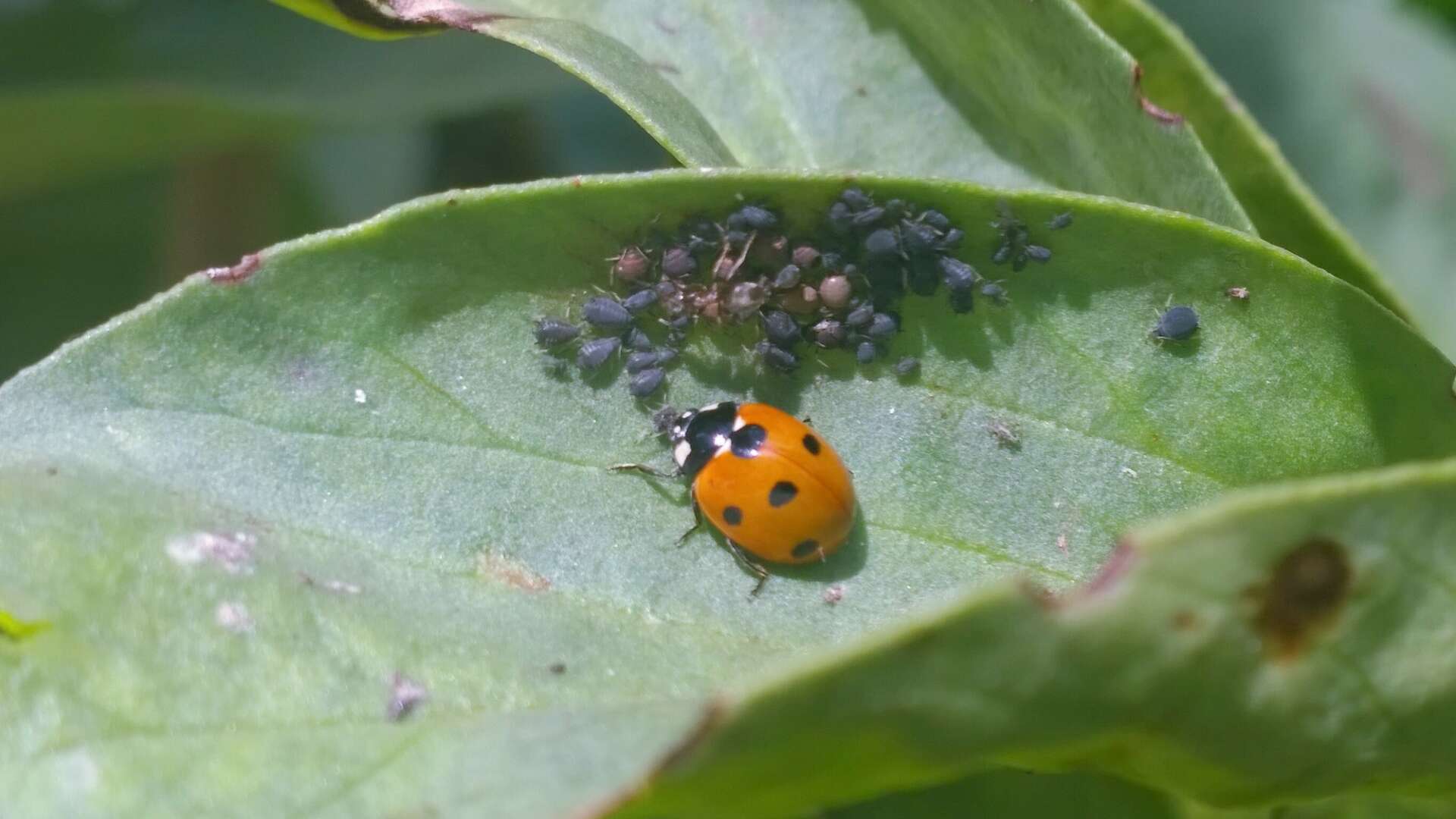
While 2024 was coined ‘Year of the slug’, 2025 earned the title ‘Year of the Aphid’ – in early summer, many plants were plastered in the pest and looked like they might not survive. So why do aphid numbers suddenly explode and what can we expect in a changing climate?
The insect survey at Rothamsted has been running since 1964 collecting yearly data from a network of suction traps around the UK(1). From this they’ve been able to build models to predict likely aphid populations in relation to temperature. One of the effects of warmer winters is that aphids migrate to crops and start to multiply earlier.
Recent work by Warwick University and the Met Office has shown that temperatures in January and February have a strong influence: just 1oC warmer during this period means that one of the common pests, the peach potato aphid, makes its first flight into crops 12 days earlier (2).
Another factor ensuring their success is that aphids build up resistance to common pesticides. During the summer, aphids go through an asexual phase where they give birth to live young. As they multiply so quickly, any selective advantage – such as a resistance to a pesticide that is sprayed frequently – will propagate very quickly though the population. A recent survey showed that in the UK, 80% of peach potato aphids showed resistance to pyrethroids, one of the most common pesticides (3).
Unfortunately, this resistance isn’t just restricted to pesticides. Some growers are starting to find that aphids are evolving resistance to some of the parasitic wasps that are commonly used for biocontrols. Recent research work at Harper Adams University is looking at the mechanisms by which this happens.
As with pesticides, if the same single biocontrol is repeatedly used against a pest, it puts a lot of pressure on the pest to evolve resistance to it. The work suggests that future biocontrols may need to contain a more diverse mixture of organisms to avoid resistance developing(4,5).
2. https://doi.org/q5s8
5. https://doi.org/q5tb
References
1. Insect Survey long-term data on aphids and moths | Insect Survey.
2. Hemming, D. et al. Likelihood of Extreme Early Flight of Myzus persicae (Hemiptera: Aphididae) Across the UK. J. Econ. Entomol. 115, 1342–1349 (2022).
3. Insecticide resistance in aphids and virus management in potatoes | AHDB. ahdb.org.uk/news/insecticide-resistance-in-aphids-and-virus-management-in-potatoes.
4. Watch: Aphid crop protection research highlighted on BBC News. Harper Adams University .
5. Martinez-Chavez, L. M., Roberts, J. M., Karley, A. J., Wamonje, F. O. & Pope, T. W. The influence of genetic variation on pre-oviposition processes for host-parasitoid co-evolution. Ecol. Entomol. 50, 1–16 (2025).