
Sowing and harvesting guidelines
Once your seeds arrive, store them in a cool dark place until conditions improve and you can sow them. We’d love to see your sowing, growing and harvesting progress so please share via @gardenorganicuk and @heritageseedlibrary, using the hashtag #SeedStories. Here’s some tips to help you get the best out of your seeds…

French bean ‘Gold Lumen’ 🔗
How to grow: Donated by John Yeoman this compact variety produces cream flowers followed by crisp, golden-yellow, stringless pods with white seeds. Find French Bean growing advice here.
How to save seed: Make sure the growing season is as long as possible to allow the pods to mature and dry. French beans are inbreeders (that is, they self-pollinate), so you can save seed from just a few plants. Nevertheless, don’t grow two varieties side by side if you intend to save seed (to avoid any mix ups!). Ideally, the pods should be dried on the vines but if bad weather threatens, uproot the plants and hang them upside down somewhere warm until the pods are completely dry. Pod the beans and put them to dry further somewhere warm and dry, but don’t allow them to get too hot. Store your seeds in paper bags somewhere cool and dry.

Tomatoes 🔗
Tomato 'Brione Gold'
Indeterminate. Cordon. One of the varieties from Italian tomato breeder, Suzanne Arregger. Produces orange, slightly flattened ribbed fruits 5-8cm in diameter. This variety produces flowers with stigma that protrude from the anther cone, so will need to be isolated from other varieties like this if seed saving.
Tomato 'Golden Gazzi'
Indeterminate. Cordon. One of the varieties from Italian tomato breeder, Suzanne Arregger. Produces slightly flattened, ribbed yellow fruits 5-8cm in diameter.
Tomato 'Golden Grape'
Determinate. Bush. Donated by John Yeoman, this variety produces small, sweet, grape-shaped, golden-yellow tomatoes. They thrive outside, cropping prolifically over a long period of time. One of our Seed Guardians describes it as "the BEST all round tomato. prolific right up to Christmas if grown under cover"!
Tomato 'Kenches Gold'
Indeterminate. Cordon. Thought to date back to at least 1901, this variety is named after our donor's grandfather, who was known as 'Kench'. The donor told us, “they produce deep yellow fruit of moderate size. A delicious, sweet-fruited variety.” Has been described as “a star performer”.
Tomato 'Ronzo Gold'
Indeterminate. Cordon. One of the varieties from Italian tomato breeder, Suzanne Arregger. Produces slightly flattened yellow fruits with gentle ribbing. This variety produces flowers with stigma that protrude from the anther cone, so will need to be isolated from other varieties like this if seed saving.
Tomato 'Dixie Golden Giant'
Indeterminate. Cordon. Produces large, slightly flattened, deep yellow-orange, beefsteak fruits. A great slicer, perfect for sandwiches and salads. This variety produces flowers with stigma that protrude from the anther cone, so if seed saving it will require isolating from other varieties of this type.
How to grow: Find tomato growing advice here.
How to save seed: Tomatoes are inbreeders, and many seed savers successfully maintain varieties by saving from just two or three plants. Most tomatoes are not capable of cross-pollination as the flowers are perfect and self-pollinating. However, there are some exceptions (as above) that produce flowers with stigma. These can collect pollen from other similar varieties, so, for safety, you should grow just one of this type a year. Remove seeds from the fruit and rinse in a sieve under cold running water, rubbing them against the sieve to remove the gel coating. Spread the seeds on a piece of greaseproof paper and allow to dry. Once fully dry, they can be stored in paper envelopes in a cool, dry place.
Carrot ‘Egmont Gold’ 🔗
How to grow: Originally from Yates of Australia, this tapering, pale orange, main-crop variety is good for late sowing. It was brought to the UK from New Zealand by the gardener at the Bishop’s Palace, Wells, in 1998. Described in 1967 in the Pedigree Seeds Catalogue as “without doubt the most tender and fully flavoured main crop carrot offered”. Find carrot growing advice here.
How to save seeds: Carrots are biennial, producing a root in the first year (the edible part) and, in their second year, spectacular ‘umbels’ made up of many tiny flowers. They will easily cross-pollinate with any other carrot in flower, and with wild carrots.
For seed production carrot roots need to be selected and stored over winter. Sow later (June or July) so that they are ready to lift and store around the end of Oct/November. We want them to be dormant in storage until re-planting in spring.
Replant only the best roots; the plants will need staking as they can grow to 1.5m or more when in flower. Carrot flowers are perfect, but they rely on insects (which they attract with their delicious fragrance) for pollination and seed set. They must also be isolated from any other carrots in flower by distances >1000m. If this cannot be achieved, the plant should be enclosed in a cage constructed of fine mesh and hand pollinated.
The seed is ripe when it turns brown, the umbels become brittle, and the barbed seeds come free of their stalks. Remove the seeds by gently rubbing the flower heads and allow them to fall off into a paper bag. They can be stored in a cool, dry place for two to three years.
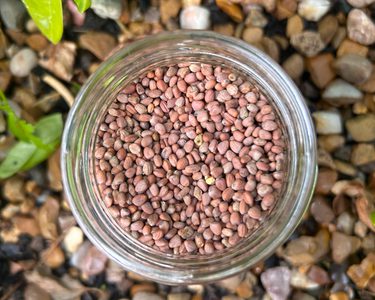
Radish ‘French Golden’ 🔗
How to grow: Noted as being quick to grow and slow to go woody. This radish produces 5-8cm long radishes with ochre-coloured skin and crisp, mild-flavoured, ice-white flesh. Find radish growing advice here.
How to save seeds: Radishes are easy to save seed from in small quantities. Leave spring and summer radishes to go straight to seed.
Radish flowers are perfect, but self-incompatible, needing insects to move pollen from plant to plant as well as from flower to flower or pods will not form. All radish varieties can cross with one another and need to be >1000m away to keep them pure, so it’s best to grow only one variety if seed saving. Plants can also be grown in a mesh cage and hand pollinated.
Radishes produce seed pods which are ready to harvest when they are dry/crispy and pale brown in colour. To remove the seeds, grate the pods through a strong, wide-mesh sieve. Another technique is to crush the pods, put them onto a flat board and slowly tilt the board vibrating slightly. The seeds should roll to the bottom of the board. Store radish seeds in paper envelopes in a cool, dry place – they should last for up to seven years.
Scottish seeds 🔗
Beet ‘McGregor’s Favourite’
A dual-purpose 19th century Scottish variety grown for both its handsome, dark red, tender leaves and for its long, conical roots. It was thought to have been lost, however, we managed to acquire seeds of this interesting beet. Could this be the beet nibbled on by the rabbits in the famous tales of Beatrix Potter as its name suggests?
How to grow beetroot: click here.
Pea ‘Alex’
The extraordinary thing about this variety is the number of peas per pod, 10-12 is usual, with 13 reported by our donor! He was passed the variety by a friend from Ayrshire who said that the variety had been grown by both his father and grandfather.
Pea ‘Purple Mangetout’
This variety originated in Clydebank and was passed to our donor, Alan Rowe, by a Scottish lady relocating to Suffolk. Alan recommends daily picking as soon as the peas begin to form in the pods to avoid any stringiness.
How to grow peas: click here