How did your veg grow in 2025
- Tags
- Members experiment archive
Each year we ask people to rate the performance of ten common crops on a scale from 1 – 5. The aim is to gather information that can be used to provide a helpful summary of how each crop responded to the climatic conditions around the UK. Over the long term, this longitudinal data will be useful for examining trends and evaluating the resilience of various crops grown at a range of locations in different seasons. A new addition this year was the Fryd app, a crop planning application with a community that also makes it easy for people to keep their own personal records in citizen science projects.
Weather
Overall, the met office confirmed that 2025 the UK’s warmest and sunniest on records.
Winter was mild with temperatures 0.5oC above average and overall slightly drier than average although there were localised periods of freezing fog towards the end of December.
Spring brought lots of extremes with the sunniest and warmest spring on records for the UK as a whole. It was also extremely dry, with large proportion of the country receiving less than 50% of the average rainfall, making it the second driest spring on record.
In summer, some much-needed rainfall fell in some areas in June and July although August was much drier only receiving 62% of the average. All three months were sunnier and warmer than average.
The autumn began with an unsettled period bringing storms with heavy rain. There were mixed periods of colder weather with frosts in late September, October and late November interspersed with very mild periods.
Summary of growing season
In the bar chart below the crops are ranked in order of performance. The ranking was determined by comparing the number of good crops to the number of poor crops. Those with large amounts of red and orange performed poorly, those with larger amounts of yellow and green performed well.
This was a very contrasting season to 2024. Whereas 2024 was defined by slugs and lack of sunshine, lack of water defined 2025. Those with decent access to irrigation, growing on more moisture retentive soils had a good growing season, especially in the second half once the rains arrived giving rise to late bumper harvests. Those on lighter soils often struggled to keep up with the watering, and often the crops that established poorly in the earlier half of the season never properly recovered. Although slugs were noted for their absence, the dry weather brought other challenges especially black bean aphids on broad beans and cabbage aphids on brassicas. Some of the growers were keen to stress that even if they achieved good results, this was through employing an array of adaptation measures such as mulching, good soil preparation through no-dig, shade cloth and successional sowing. It is interesting, that again, runner beans, a once dependable favourite is not fairing well under climate extremes.
Individual crops:
Brassicas
Brassicas had a difficult time in the earlier part of the season. Quite a few crops suffered from pest problems particularly aphids and cabbage white butterflies, and others found that early brassicas bolted. However, by late summer and early autumn, the aphid problem had departed and if they had survived, the plants made a good recovery providing good autumn harvests.
Runner beans
Runner beans were at the bottom of the table again, similar to the dry season of 2022. Inability to water adequately at start of the season was the most common reason for poor yields leading to 48% of crops producing no or poor yield. Some crops failed completely, failing to climb, whilst other noted poor flowering, flowers dropping or pods not setting at all. Some managed to achieve a crop once the rains returned in September, achieving a very late harvest
Chard
Chard had a difficult period in the early summer, with the lack of water, and succumbed to powdery mildew. During this period, growth was stunted and harvests poor. However, many noted that it recovered well with the autumn rain and started producing reasonable harvests. Overall, its performance was one of the better crops with slightly more good crops than poor crops
Amaranth
Amaranth was only grown by a small proportion (12%) of growers, so comments were very limited. One person noted that purple amaranth was a ‘star crop’ that thrived when most other leafy crops struggled.
Squashes
At least squashes were spared the slug attacks from 2024, but crops were very inconsistent in 2025. Those that were able to establish good plants managed to achieve good yields if they were able to supply enough water or were growing on a moisture retentive soil. However, 40% achieved no or very poor yields. Many noted poor fruit set or stalled plants that never recovered even when the rains came. Powdery mildew came in especially early with the dry weather.
Lettuces
Again, people were grateful for the lack of slugs compared to 2024. However, lettuces were generally very challenging to grow in the summer heat and bolted prematurely even when watered adequately. Rapid successive sowing was necessary in order to maintain any continuity as the plants bolted so quickly
Tomatoes
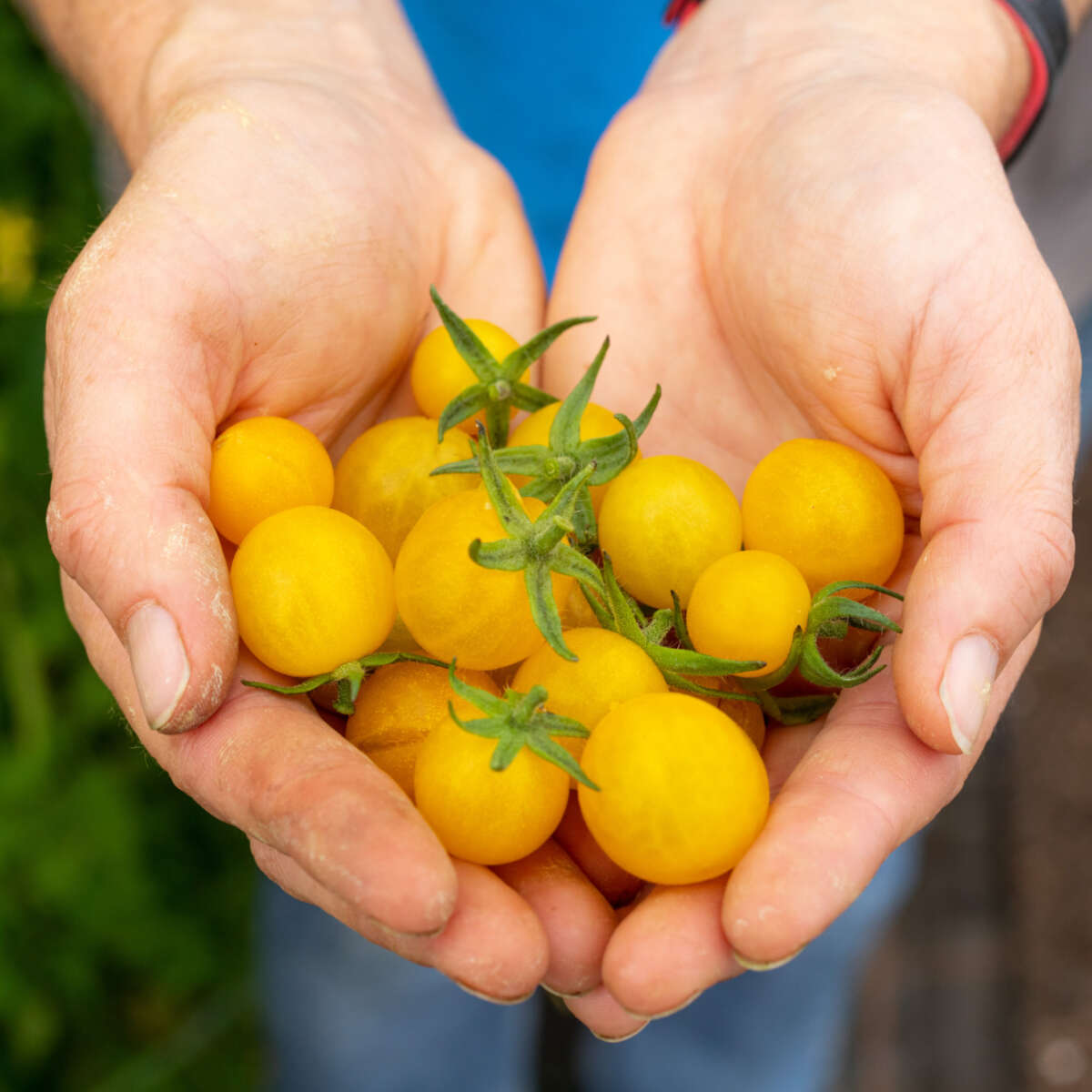
Tomatoes were the strongest performer in 2025 with three times as many achieving good or excellent yields compared to crops suffering poor yields. Providing consistent watering to a smaller number of glasshouse or pot plants was a more achievable task than with other crops covering a larger area and the plants thrived in the hot dry spell producing high yields. Some people noted the common problems associated with irregular watering such as blossom end rot and split fruits.
Potatoes
Potatoes also struggled in the heat and dry soil and needed a lot of watering. Although some did achieve good results and were grateful for the lack of blight and slugs, many reported undersized tubers and problems such as scab associated with low soil moisture.
Carrots
Carrots were a very mixed picture this year. Germination was a struggle for many with the soil being too hot and dry, with some failing even after resowing. However, many that did establish crops actually managed to achieve respectable yields once the rains returned, with some noting that it was the best carrot harvest in years. A lack of slug damage and low carrot fly pressure were mentioned a few times, meaning that less carrots were spoiled.
Onions
Onions were a mixture of failures and successes. Those that maintained the moisture using mulch or no dig beds achieved good yields, with a few calling them “their best onions ever”. However more growers achieved poor growth or small bulbs, with some not even bulking up to the size of their sets. Lack of watering, where water was often prioritised elsewhere and hard compacted dry soil contributed to these poor yields.
Full summary table
1. Disaster very little or no crop | 2. Poor crop, less than usual | 3. Average crop, similar to usual | 4. Good crop, better than usual | 5. Excellent crop, much better than usual | No. growers | % of growers growing this crop | Ratio of good to poor crops | |
Runner beans | 13 | 32 | 30 | 19 | 6 | 219 | 73 | 0.556 |
Squash | 11 | 29 | 27 | 24 | 9 | 258 | 86 | 0.808 |
Onions | 13 | 24 | 32 | 19 | 12 | 194 | 65 | 0.833 |
Brassicas | 10 | 24 | 38 | 22 | 5 | 232 | 77 | 0.800 |
Carrots | 21 | 15 | 26 | 28 | 11 | 178 | 59 | 1.063 |
Potato | 4 | 22 | 40 | 24 | 9 | 229 | 76 | 1.246 |
Amaranth | 8 | 14 | 50 | 14 | 14 | 36 | 12 | 1.250 |
Lettuce | 8 | 14 | 45 | 28 | 6 | 220 | 73 | 1.574 |
Chard | 5 | 11 | 50 | 25 | 9 | 208 | 69 | 2.088 |
Tomato | 3 | 15 | 26 | 30 | 26 | 274 | 91 | 3.143 |